
Building the DNA of a Successful Momentum Investor - Navy Vijay Ramavat
A Short Key Takeaways and Insights from Face2Face Podcast between Navy Vijay Ramavat and Vivek Bajaj.

"In this issue, I'm breaking down the most impactful lessons I learned from the Podcast Between Navy Vijay Ramavat and Vivek Bajaj.
Whether you're looking to deepen your understanding of Momentum Investor or simply curious about what stood out, here's a concise overview of the video that helped broaden my perspective.
Core Philosophy of Momentum Investing
Momentum investing focuses on short to medium-term opportunities, targeting the best-performing stocks that are in their best phase. The key principles include:
✅ Staying in cash when markets are weak – sitting on cash provides fresh investment opportunities.
✅ Re-entering stocks at the right time – avoiding emotional attachment and focusing on market trends.
✅ Understanding price trajectory – identifying strong price movements backed by fundamentals.
✅ Proper money management – risk allocation and disciplined exits.

Understanding Market Cycles Through Human Age Phases
Navy Vijay compares stock behaviour to human growth:
📌 Toddler to Teen Stocks – Less known, small and mid-cap, hitting new highs.
📌 Adult Stocks – Well-known, experienced a significant price increase.
📌 Rejuvenated Stocks – Those that recover due to sector tailwinds, acquisitions, or new management.
By recognizing where a stock stands in its lifecycle, investors can make timely entry and exit decisions.
The Evolution of a Trader
A successful trader evolves through learning and experience:
📌 Find a Guru – Learn from experts.
📌 Read Books – Constant learning is crucial.
📌 Deploy Real Money – Start small but get hands-on experience.
📌 Have an Entry & Exit Plan – Every trade must have a defined strategy.
Essential Guidelines for Aspiring Traders
❌ Avoid futures trading for the first 3 years.
❌ Avoid options trading unless you're a full-time trader.
❌ Avoid leverage until you have at least 2 years of success in the markets.
Momentum Investing Tools & Patterns
Momentum traders rely on technical patterns and fundamental triggers:
🔹 123 Pattern – Helps identify trend reversals.
🔹 Pennant Pattern – A breakout trade setup that follows a sharp rally.
🔹 Flag Pattern – A consolidation phase before a strong breakout.
🔹 Cup & Handle Pattern – A bullish continuation pattern.
🔹 IPO Bases – Identifying strong IPO stocks with potential breakouts.
By recognizing these patterns early, traders can capitalize on high-probability moves.
Risk Management & Exit Strategies
📌 Define Your Risk – Not knowing the risk is the biggest risk.
📌 Avoid Risk of Ruin – Never take trades that can wipe out your portfolio.
📌 Use Stop-Loss Logic –
Move stop-loss to cost after a 5-10% gain.
Exit using EMAs (10, 21, 50-day) for trend confirmation.
Use last swing lows to exit with predefined quantity reductions (50%, 30%, 20%).
When to Book Profits?
✅ In extreme movements (euphoria phases).
✅ During big events (elections, policy changes).
✅ If profits accumulate quickly, start trimming.
✅ Use trailing stop-losses (5-10%) during strong uptrends.
Portfolio Allocation Strategy
A momentum portfolio should be well-diversified yet focused:
📌 Max 25 stocks in a ₹10 lakh portfolio.
📌 Individual stock exposure is capped at 10-20%.
📌 Stage-based Allocation:
Base Breakouts – 1-3% per stock.
Confirmed Breakouts – 2-6% per stock.
Follow-up Breakouts – 0.5-1% per stock.
Capital Management Rules
✔ If MTM (Mark-to-Market) is not increasing, reduce exposure.
✔ If losses persist for a month or quarter, shift to 100% cash.
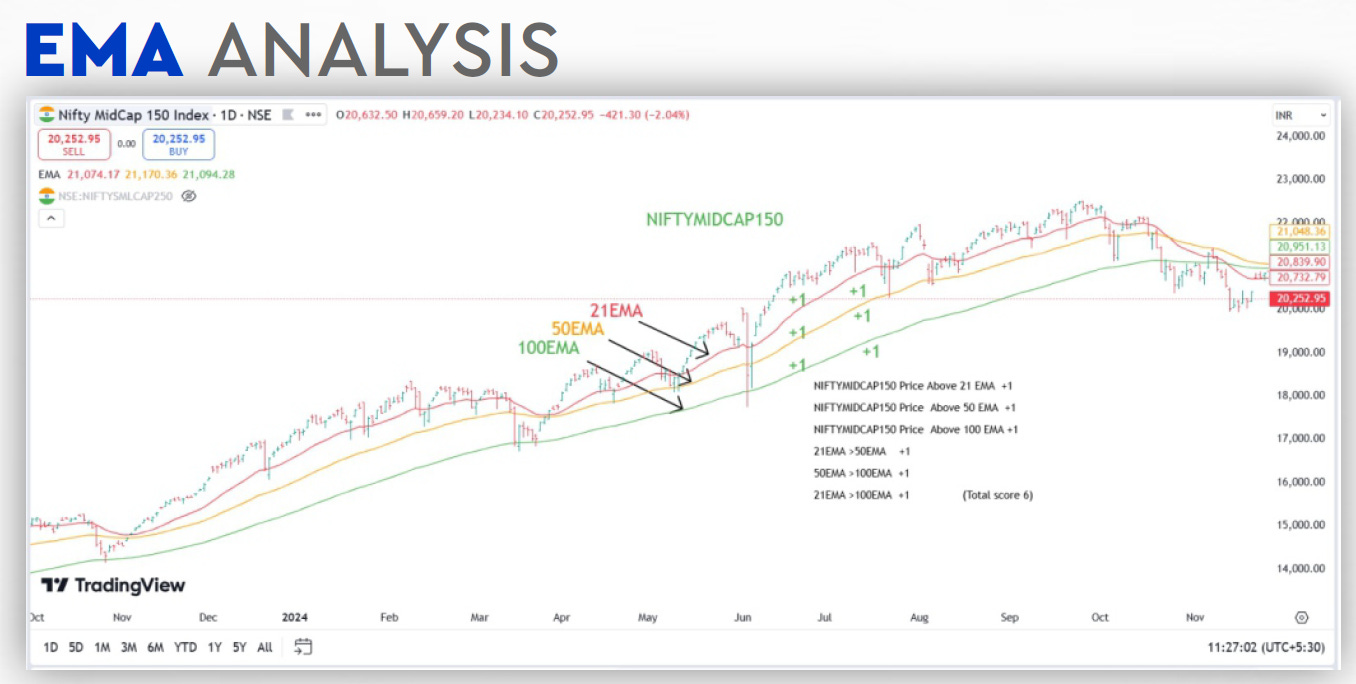
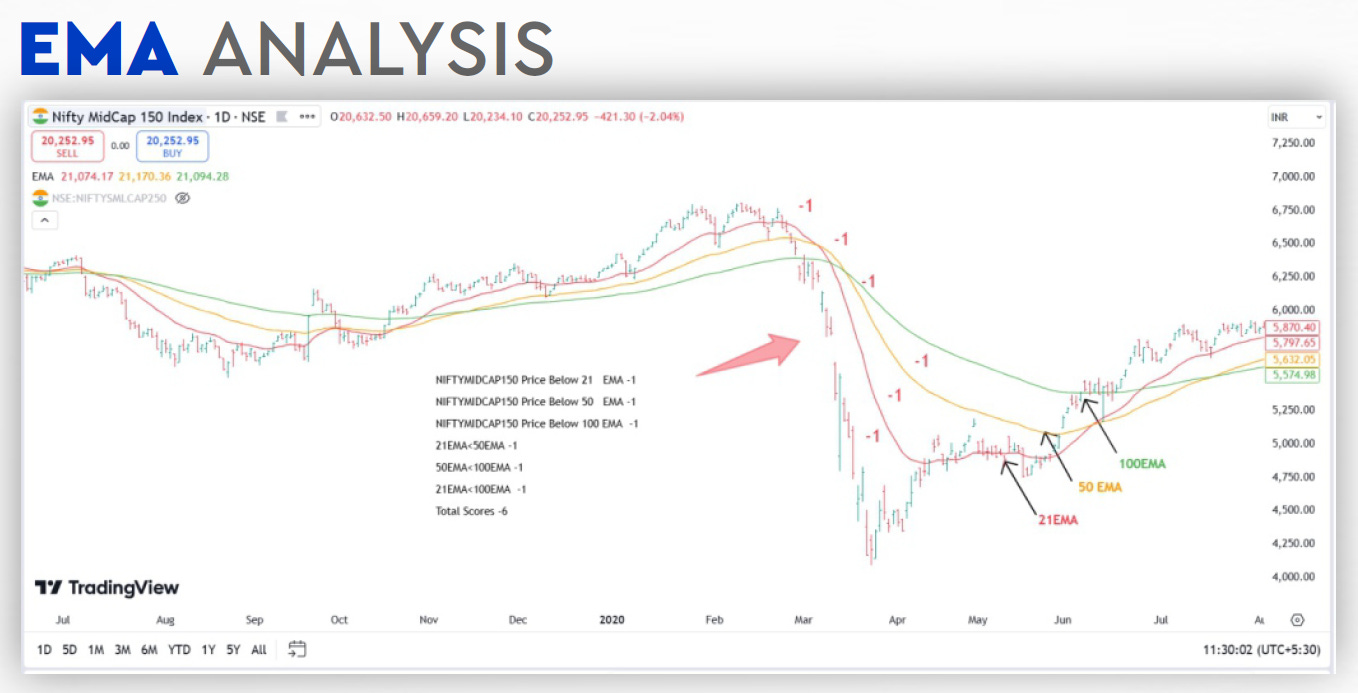
EMA-Based Allocation Model
Navy Vijay emphasizes Exponential Moving Averages (EMA) for dynamic allocation:
📌 Price vs EMA scoring system determines stock strength.
📌 Higher scores indicate bullish momentum and lower scores indicate bearish risk.
📌 This helps in portfolio balancing and position sizing.
RULES FOR EMA ANALYSIS
Scoring System:
If price > EMA level → Assign +1
If price < EMA level → Assign -1
If EMA 21> 100 EMA → Assign +1
If EMA 21> 50 EMA → Assign +1
If EMA 50> 50 EMA → Assign +1
If EMA 21 < 100 EMA → Assign -1
If EMA 21 < 50 EMA → Assign -1
If EMA 50 < 50 EMA → Assign -1
Summing Up the Scores:
The scores for Above EMA and Below EMA are summed for each stock/index.
A positive score indicates a bullish trend (the price is above multiple EMAs).
A negative score indicates a bearish trend (the price is below multiple EMAs).
Common Fallacies & Market Realities
🚫 Expensive stocks can become more expensive – momentum drives valuation.
🚫 Best past performers may not be the best future performers – don’t hold onto laggards.
🚫 Cash is a position – sometimes the best move is to wait.
🚫 Stop-losses protect capital – losing small is key to long-term success.
🚫 Falling stocks rarely make you money – strong stocks give better returns faster.

Learning Principles for Traders
🔹 You don’t make money; the market gives you money.
🔹 Patience leads to better entry points.
🔹 Excess information should be used for validation, not execution.
🔹 Only 4-5 out of 10 trades need to be correct to be profitable.
Final Takeaways: Implanting the DNA of a Successful Trader
✅ Trade with a well-defined philosophy.
✅ Recognize stock cycles and patterns.
✅ Avoid unnecessary risks and use proper money management.
✅ Be disciplined in exits and protect capital.
✅ Learn continuously and adapt.
Momentum investing requires skill, discipline, and patience. By following these principles, traders can build a robust trading strategy and consistently outperform the markets.
Would love to hear your thoughts! Do you practice momentum investing? Share your experiences in the comments. 🚀